
Lean
Design a management model aligned with your business.
The Lean approach helps companies improve processes, organization, and performance through a more streamlined, efficient, and value-oriented way of working.
At its core, Lean is based on a simple principle: identifying what creates value for the customer and reducing everything that slows down, burdens, or dilutes resources. When correctly applied, the Lean methodology enables higher efficiency, improved quality, waste reduction, and the development of a stronger, more responsive organization. This direction is consistent with how AGMC presents its business improvement initiatives.
At AGMC, we develop Lean pathways with an operational and managerial approach, tailored to the company’s context and aimed at concrete, measurable, and long-lasting results.
Lean Management: governing the organization more effectively
Lean Management applies Lean principles to the overall governance of the company, with the aim of making decision-making processes more fluid, roles clearer, and coordination between business functions more consistent.
The intervention begins with an analysis of workflows, responsibilities, bottlenecks, and non-value-adding activities. From this, a more transparent system is built, where priorities are clearly defined, activities are continuously monitored on a daily basis, and decisions are supported by solid operational data and facts. This type of pathway fully aligns with Lean consulting logic, which starts from analysis, defines an improvement plan, and supports it through continuous monitoring.
The result is a leaner organization, more adaptable to change and more strongly oriented toward continuous improvement.
With Lean Management, it becomes easier:
- To gain a clear view of processes
- To reduce waste
- To increase production capacity
- To identify the optimal balance between flexibility, efficiency, and cost
- To foster teamwork and alignment on shared objectives
- To reduce the cost–quality gap
THE 8 WASTE CATEGORIES
WASTE = anything that is done without adding value the customer is willing to pay for
OVERPRODUCTION
TRANSPORTATION
WAITING
OVERPROCESSING
DEFECTS
INVENTORY
MOTION
UNUSED TALENT
Lean Production: leaner flows, less waste, higher productivity
Lean Production focuses on operational and production processes to improve flow, reduce inefficiencies, and increase the company’s ability to generate value in a stable way.
The analysis focuses on activities that slow down production, bottlenecks, waiting times, unnecessary movements, rework, and all factors that negatively impact time, cost, and quality. The underlying logic is the same: clearly distinguish value-adding activities from those that do not contribute to the product/service.
Through an analysis of the current state of processes and a targeted design of the future state, the company can build smoother flows by identifying the best sequence of activities and a more efficient management of resources, materials, logistics, and production capacity. Tools such as detailed process mapping find their most direct application here.
LEAN = LEANER PROCESSES = WASTE REDUCTION
“Do it better” / “Do it faster” / “At lower cost”

Continuous Flow

Operational
Efficiency

Higher
Productivity

Lower
Costs

Certified
Quality
Benefits of Lean Production in the company
Lean Production helps:
- reducing waste and create continuous flows
- optimizing/standardizing production flow and increase process efficiency
- increasing productivity and efficiency
- reducing costs, lead times, and rework, and optimizing the value chain
- strengthening the quality of the process and of the output (product/service)
Kaizen Method: continuous improvement as a daily practice
The Kaizen event is one of the pillars of the Lean methodology. It is based on the idea that the most effective improvement is the one built over time, through continuous, incremental, and practical actions.
This method involves empowering and actively engaging all employees, with the aim of identifying problems and developing possible solutions. Improvement is not confined to an isolated project but it becomes an organizational standard and part of the way work is done. The source text in fact highlights Kaizen workshops as a key tool of Lean consulting and identifies continuous improvement as essential to maintaining stable results over time.
Applying the Kaizen method means creating structured moments of analysis, discussion, and action, with the goal of correcting inefficiencies, simplifying flows, and progressively consolidating new organizational standards.
KAIZEN METHOD
Continuous improvement as a daily practice

Analysis

Engagement

Action

Standardization

Repeat
Value for the company
The Kaizen Method promotes:
- greater employee engagement
- a constant focus on actual problems
- rapid, targeted interventions
- encouraging employees to take a proactive approach
- consolidating continuous improvement
Corporate efficiency: improving performance in a concrete way
Corporate efficiency is the result of well-designed processes, clear roles, orderly flows, and widespread capability to identify and resolve issues.
The Lean approach helps build this balance by deeply intervening in the organization: it reduces non-value-adding activities, it improves resource utilization, it strengthens process control, optimizes space, it reduces customer lead time, and it makes collaboration between functions smoother. In the source material, key Lean consulting benefits include waste reduction, productivity increase, quality improvement, employee engagement, and resource optimization.
When consistently implemented, this pathway delivers tangible benefits both operationally and competitively: higher productivity, better quality, lower costs, and a more flexible structure capable of adapting to change. This also reflects AGMC’s vision, focused on effective solutions, concrete performance improvement, and lasting value for the client.
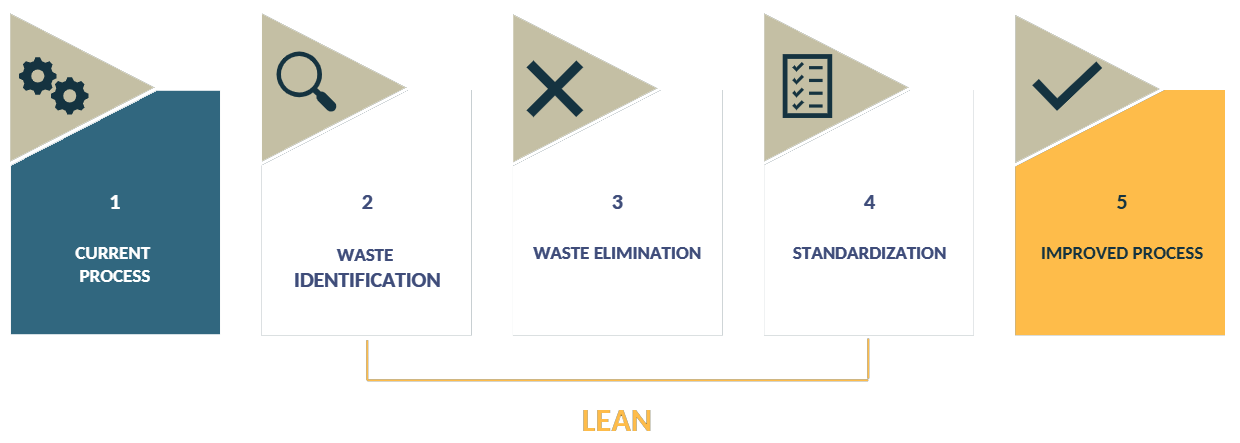
THE VALUE SEQUENCE
How we work
We support the company through a structured pathway that starts with an analysis of the current state, identifies areas for improvement, and defines concrete interventions to be implemented within processes. This approach is fully aligned with the Lean framework described in the source document: analysis, design of interventions, implementation, and results monitoring.
Activities may include:
- analysis of flows and inefficiencies
- process mapping and identification of bottlenecks
- definition of the improvement plan
- operational support during implementation
- team involvement and results monitoring
The objective is to build a more efficient, leaner, and more sustainable process capable of generating measurable results over time.
Bring Lean improvement into your organization
From process management to operational performance, Lean methodology can become a concrete lever to reduce waste, increase efficiency, and strengthen business competitiveness.
Contact AGMC to build a Lean pathway aligned with your organization.